On a standard 400 metre outdoor track, one mile is just over 4 laps in lane 1. Four laps cover 1,600 metres, and a mile is 1,609.34 metres, so a true mile is 4 laps plus about 9 metres. In the outer lanes each lap is longer, so you need fewer laps.
In this guide
Laps per mile in each lane
| Lane | Approximate lap length | Laps for 1 mile |
|---|---|---|
| 1 | 400 m | 4.02 |
| 2 | 407 m | 3.95 |
| 3 | 415 m | 3.88 |
| 4 | 423 m | 3.80 |
| 5 | 430 m | 3.74 |
| 6 | 438 m | 3.67 |
| 7 | 446 m | 3.61 |
| 8 | 453 m | 3.55 |
Figures are approximate and assume a standard track with lanes 1.22 metres wide. Each lane out adds roughly 7 to 8 metres per lap.
How big is a standard running track?
Outdoor tracks used for competition, including the Olympic Games, follow World Athletics specifications:
- Lap length: 400 metres, measured 30 cm out from the inside edge of lane 1
- Straights: about 84.39 metres each
- Bends: two semicircles with a radius of about 36.5 metres
- Lane width: 1.22 metres
- Lanes: usually 8, sometimes 9
- Direction: races are run anticlockwise
Common distances in laps (lane 1)
| Distance | Metres | Laps |
|---|---|---|
| Quarter mile (approx.) | 400 | 1 |
| Half mile (approx.) | 800 | 2 |
| 1,500 m (“metric mile”) | 1,500 | 3.75 |
| 1 mile | 1,609 | 4.02 |
| 2 miles | 3,219 | 8.05 |
| 5K | 5,000 | 12.5 |
| 10K | 10,000 | 25 |
| Half marathon | 21,097.5 | About 52.75 |
Related: What Is Pronation? Overpronation vs Supination Explained
Why the outer lanes are longer
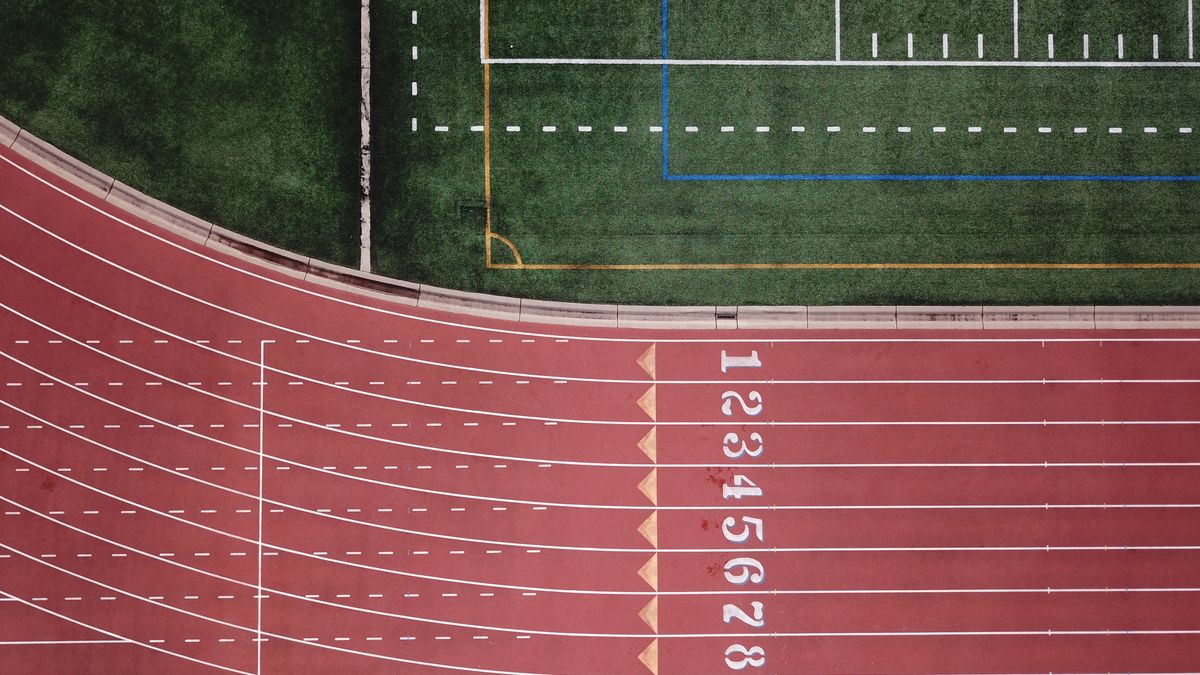
Every lane has the same straights, but the bends in the outer lanes have a larger radius, so the curve is longer. That is why races run in lanes, such as the 200 m and 400 m, use staggered start lines: the runner in lane 8 starts further forward so that everyone covers the same distance.
What about indoor and school tracks?
- Indoor tracks are usually 200 metres, so a mile is about 8 laps in lane 1.
- Older tracks in some countries were built to 440 yards (402.3 metres), on which a mile is exactly 4 laps.
- Small school or park tracks can be 300 metres or less. Check for a sign, or measure a lap with a GPS watch over several laps and average the result.
Track etiquette
- Run anticlockwise unless the track posts a different direction for the day.
- Keep lane 1 and 2 clear for faster runners doing timed efforts; jog and walk in the outer lanes.
- Look both ways before crossing the track.
- Do not stop suddenly in an inside lane; step to the outside or the infield.
Tips for running a mile on the track
- Start four laps from the finish line and add about 9 metres at the start for a true mile. Many tracks have a marked mile start line a few metres behind the usual line.
- Use each lap as a pacing check. For an 8-minute mile, aim for 2 minutes per lap.
- Warm up with 5 to 10 minutes of easy jogging first.
For training ideas, see how to run a faster mile and how often you should run.
Just starting out? See the best running shoes for beginners.
Frequently asked questions
Is 4 laps around a track exactly a mile?
Not quite. Four laps of a 400 m track is 1,600 metres, about 9 metres short of a mile.
How many laps is a 5K on a track?
12.5 laps in lane 1.
How many laps is a mile on an indoor track?
About 8 laps on a standard 200 metre indoor track.
How long is one lap in lane 8?
Roughly 453 metres on a standard track, about 53 metres more than lane 1.