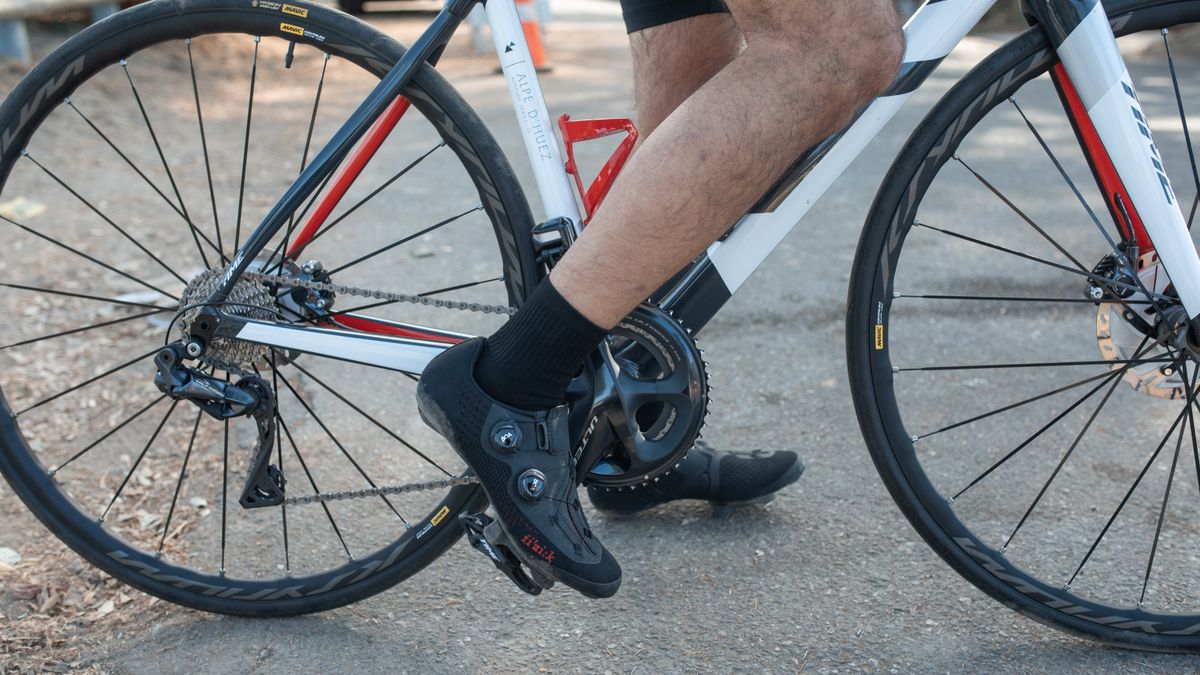
Cycling shoes should fit snugly, closer than running shoes, with your heel held firmly in place, a few millimetres of space in front of your toes, and no pinching across the forefoot. Your foot should not slide when you pull up on the pedals. Because the soles are stiff and do not flex, a shoe that fits wrong will not “break in”, so the fit has to be right from the start.
In this guide
Fit checklist
| Area | Good fit | Problem sign |
|---|---|---|
| Toes | About 3 to 5 mm of space; toes can wiggle slightly | Toes touching the end, numbness, or lots of spare length |
| Forefoot | Held without squeezing at the widest point | Hot spots, burning or tingling on rides |
| Arch | Supported; insole follows your arch | Arch ache, foot collapsing inward |
| Heel | No lift when you pull up | Heel slipping or rubbing |
| Upper | Even pressure from straps, dials or laces | Pressure on the top of the foot |
Why cycling shoes fit differently
- Your foot does not roll forward as it does when walking, so you need far less toe room than in running shoes.
- A stiff sole transfers power efficiently, but it means the upper must hold your foot without any help from flex.
- Feet swell on long, hot rides, so a shoe that is tight at the start becomes painful after an hour.
How to try them on
- Try shoes in the afternoon, wearing thin cycling socks.
- Stand up with your weight on both feet and check toe room.
- Tighten the closures from the toe end upward. They should feel secure without cutting in.
- Rise onto your toes and try to lift your heel; it should stay put.
- If you can, clip in on a bike or trainer and pedal for a few minutes.
European sizing is standard for cycling shoes, and brands vary noticeably in width. Some offer wide versions. Measure your feet first; see how to measure your shoe size and shoe widths explained.
Related: How Many Miles Is a Half Marathon? Distance and Pace Chart
Road, mountain bike and indoor shoes
- Road shoes: very stiff, smooth soles with a 3-bolt cleat mount. The cleat sticks out, so they are awkward to walk in.
- Mountain bike and gravel shoes: a 2-bolt cleat recessed into a treaded sole, so you can walk normally.
- Indoor cycling shoes: depend on the bike’s pedals. Many studio bikes accept 2-bolt cleats, some accept 3-bolt; check before buying.
- Flat pedal shoes: grippy rubber soles and no cleats.
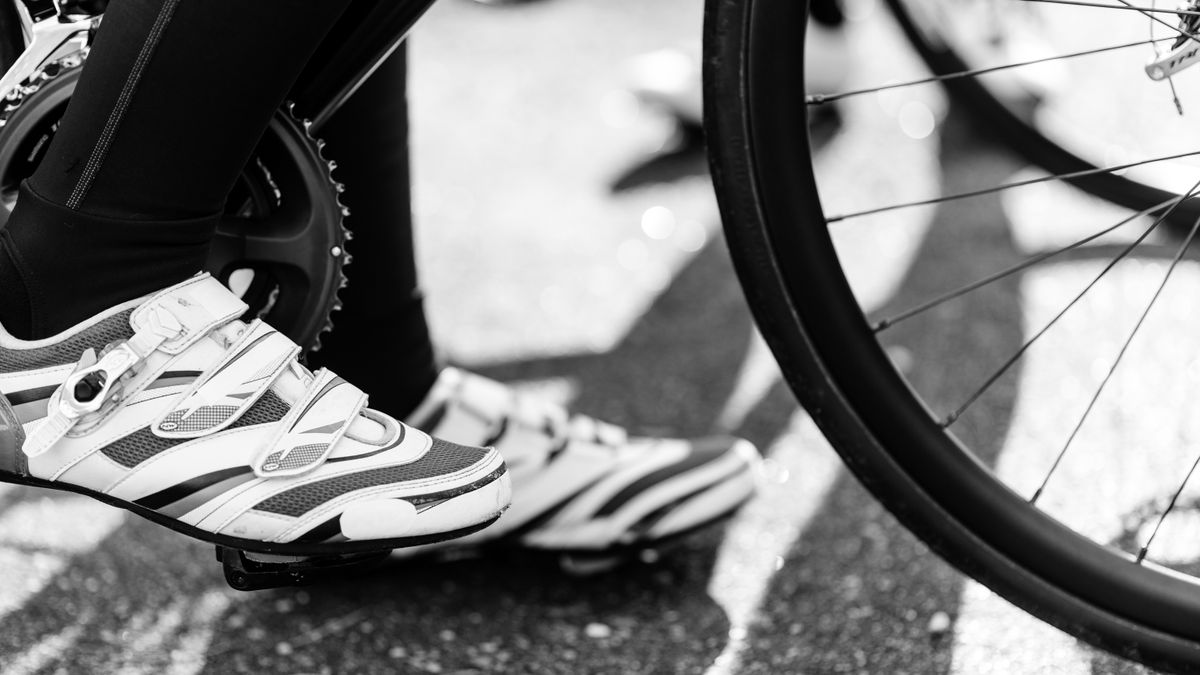
How to put cleats on cycling shoes
- Find the ball of your foot. With the shoe on, feel for the bony bump at the base of your big toe and the one at the base of your little toe, and mark both on the shoe with tape.
- Fore and aft: position the cleat so its centre sits on, or slightly behind, the line between those two marks.
- Side to side: start with the cleat centred. Move it to adjust how close your foot sits to the crank.
- Rotation: angle the cleat so your foot rests in its natural position on the pedal, usually with the heel very slightly inward. Do not force your foot straight.
- Grease the bolt threads lightly and tighten the bolts evenly to the torque marked on the cleat or shoe.
- Test and adjust. Ride for a few minutes and make small changes. Mark the final position with a pen so you can replace cleats in the same place.
Cleats with some “float” let your foot rotate a few degrees, which is kinder to the knees and a good choice for most riders. If you get knee pain, a professional bike fit is worth the cost.
Common problems and fixes
- Numb toes: loosen the front closure, check the shoe is wide enough, or move the cleat back slightly.
- Hot spots under the ball of the foot: try a supportive insole, check cleat position, and avoid overtightening.
- Heel slip: tighten the upper closure or try a narrower heel shape.
- Arch pain: a cycling insole with the right arch height usually helps.
Care
Wipe shoes clean after wet rides, remove the insoles and stuff the shoes with paper to dry; see how to dry shoes. Replace cleats when they become hard to clip in or release unexpectedly.
Frequently asked questions
Should cycling shoes be tight?
Snug, not tight. Your foot should not move inside the shoe, but you should feel no pinching or numbness.
Should I size up in cycling shoes?
Not usually. Extra length causes sliding and poor cleat position. If the shoe feels narrow, look for a wide version instead.
Do cycling shoes stretch?
Very little. Synthetic uppers and stiff soles hold their shape, so buy the fit you need.
What is the difference between 2-bolt and 3-bolt cleats?
2-bolt cleats are small and recessed, used for mountain biking, gravel and many indoor bikes. 3-bolt cleats are larger, used on road shoes for a wider, more stable platform.