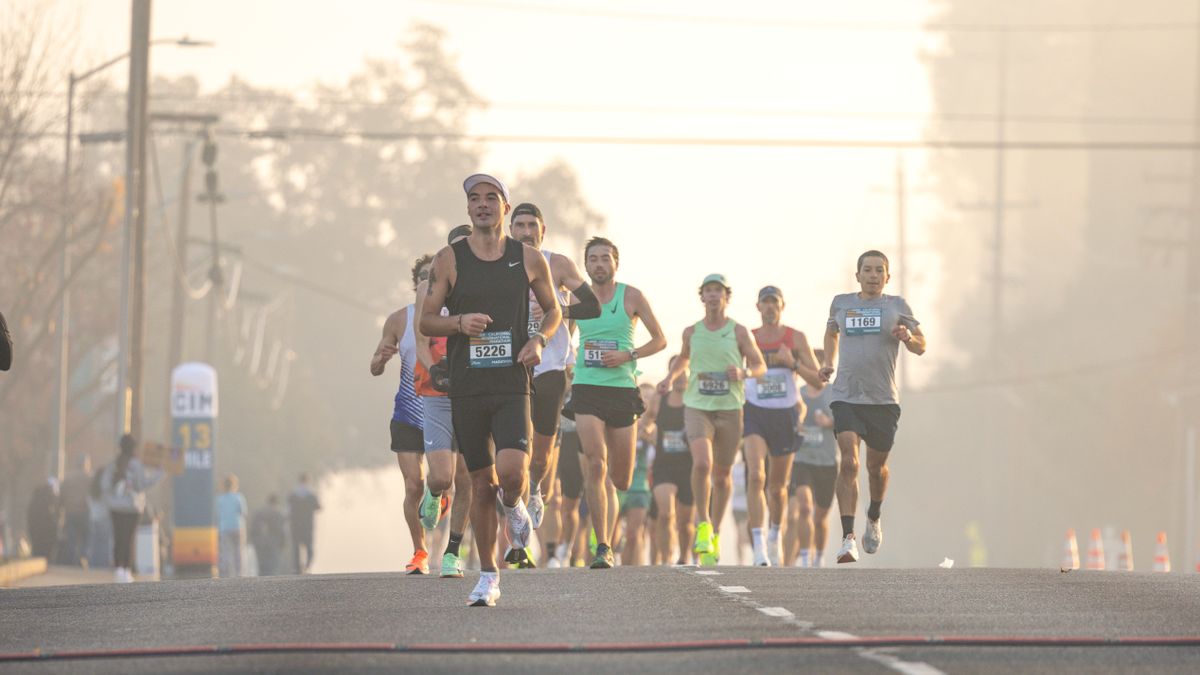
A half marathon is 13.1 miles, or 21.1 kilometres. The exact distance is 13.1094 miles (21.0975 km), which is precisely half of the marathon distance of 26.2 miles (42.195 km).
In this guide
Half marathon distance at a glance
| Measure | Distance |
|---|---|
| Miles | 13.1 |
| Kilometres | 21.1 |
| Laps of a standard 400 m track | About 52.75 |
| 5K races back to back | A little over 4 |
| Approximate steps | 20,000 to 25,000, depending on stride length |
Half marathon pace chart
| Finish time | Pace per mile | Pace per km |
|---|---|---|
| 1:30 | 6:52 | 4:16 |
| 1:45 | 8:01 | 4:59 |
| 2:00 | 9:09 | 5:41 |
| 2:15 | 10:18 | 6:24 |
| 2:30 | 11:27 | 7:07 |
| 3:00 | 13:44 | 8:32 |
How long does it take to run a half marathon?
Most recreational runners finish somewhere between about 1 hour 50 minutes and 2 hours 30 minutes. Breaking two hours is a popular goal and needs an average pace of 9:09 per mile (5:41 per km). Walkers and run-walkers commonly take 3 to 4 hours, and most large events have cut-off times in that range. Elite athletes run it in around an hour.
A “good” time depends on your age, experience and the course. For a first half marathon, finishing comfortably is the goal that matters.
Related: Best Walking Shoes of 2026: 7 Comfortable Picks
How long does it take to train?
- Already running 3 times a week: 8 to 10 weeks.
- Can run a 5K comfortably: about 12 weeks.
- New to running: 16 to 20 weeks, starting with run-walk intervals.
A typical beginner plan has three or four runs a week: two easy runs, one slightly faster run and one long run that grows by about a mile each week, peaking at 10 to 12 miles a couple of weeks before race day.
Tips for your first half marathon
- Build up gradually. Increase weekly distance slowly to give your body time to adapt.
- Start slower than you think. Going out too fast is the most common race-day mistake.
- Practise fuelling. For runs over an hour, most people benefit from water and some carbohydrate. Test it in training, never for the first time in the race. See how long to wait after eating to run.
- Taper. Cut your mileage in the final one to two weeks so you start fresh.
- Nothing new on race day: no new shoes, socks, kit or food.
Shoes for half marathon training
You will cover a few hundred miles in training, so comfortable, well-fitting shoes matter more than any other piece of kit.
- Leave about a thumb’s width in front of your longest toe; feet swell on long runs. See how running shoes should fit.
- Choose the pair that feels most comfortable when you run in it. Our explainer on pronation covers neutral and stability shoes.
- Wear them for several weeks of training before the race.
- Check the mileage on older shoes; cushioning fades with use.
If you are new to running, have a health condition, or get pain that does not settle with rest, check with a doctor or physiotherapist before starting a training plan. This article is general information, not medical advice.
How the half marathon compares with other races
| Race | Miles | Kilometres |
|---|---|---|
| 5K | 3.1 | 5 |
| 10K | 6.2 | 10 |
| Half marathon | 13.1 | 21.1 |
| Marathon | 26.2 | 42.2 |
New to running? Start with the best running shoes for beginners.
Frequently asked questions
How many km is a half marathon?
21.1 kilometres, or 21.0975 km exactly.
Is 2 hours a good half marathon time?
Yes. Finishing in two hours is a solid result for a recreational runner and a common target.
Can a beginner run a half marathon?
Yes, with 12 to 20 weeks of gradual training, depending on your starting fitness.
Can you walk a half marathon?
Yes. At a brisk walking pace it takes roughly 3 to 4 hours. Check the event’s cut-off time before entering.